NTFS Permissions Auditor is a free folder permission audit tool that scans your Windows file shares and maps out every permission — including nested group memberships. Analyze folder permissions, report who has access to what, and track permission changes over time — no PowerShell scripts needed.
On-premises desktop tool Free version available Pro from $299
No email required, no time limit
Try Pro free for 7 days
One-time purchase · 1 year of updates
Export, scheduling, change reports
No scripts. No complex setup. Just results in minutes.
Pick specific folders, enter a network path, or let NTFS Permissions Auditor auto-discover all shares on a file server or across an entire domain. Works with local drives, UNC paths, and DFS.
The tool reads every folder's ACL, resolves all group memberships (including nested groups), and builds a complete permission map. No configuration needed — just click and wait.
Browse results in folder view or account view. Filter by user, group, or permission level. Export to Excel, PDF, CSV, HTML, or XML for compliance documentation.
Write Get-Acl scripts, parse ACL objects, resolve group nesting, format outputs
Time: 3-4 hours per file serverSelect path, click Audit, done
Time: Under 5 minutes16 MB download | Installs on your workstation | No agents on file servers
| Common Permission Audit Tasks | Using PowerShell Scripts | Using NTFS Permissions Auditor |
|---|---|---|
| Audit 10 file shares | 3-4 hours writing and debugging scripts | Under 5 minutes |
| See all folders a specific user can access | Very complex — must resolve all nested group memberships | Built-in Account View — one click |
| Generate compliance report (Excel/PDF) | Additional scripting for formatting and export | One-click export to 5 formats |
| Track what permissions changed since last month | You'd need to build your own comparison system | Built-in change reports (Pro) |
| Find folders accessible by "Everyone" | Custom filter logic per script | Advanced filter manager (Pro) |
A step-by-step walkthrough of auditing folder permissions across your Windows file servers
Every Windows file server accumulates permission sprawl over time. Users change roles, groups get nested inside other groups, and temporary access grants become permanent. The result: folders accessible by people who shouldn't have access, orphaned SIDs from deleted accounts, and "Everyone" permissions on sensitive data that nobody realizes are there.
Manually checking permissions with PowerShell (Get-Acl) works for a single folder but doesn't scale. You'd need to write scripts that recursively traverse directory trees, resolve nested group memberships, handle inheritance, and then format the output into something usable. For a file server with thousands of folders, this takes hours — and misses nested group access that isn't visible in raw ACLs.
NTFS Permissions Auditor reads ACLs across your entire folder structure, queries Active Directory to resolve every group membership (including nested groups), and presents results in two views that answer the two fundamental permission audit questions:
Folder View — "Who has access to this folder?" Click any folder in the tree to see every user and group with permissions, whether they're inherited or directly assigned, and the exact permission level.
Account View — "What can this user access?" Expand any user or group to see every folder they can reach — including access inherited through nested group membership that isn't obvious from the raw ACL.
The Pro version exports full permission reports to Excel (XLSX), PDF, CSV, HTML, and XML. You can generate folder-centric reports (organized by directory structure) or account-centric reports (organized by user/group) — whichever format your auditors need. Customizable export fields let you include exactly the data points required for SOX, HIPAA, PCI DSS, GDPR, or internal security reviews.
One-time audits show current state, but ongoing monitoring requires comparing snapshots. The Pro version stores audit results automatically and lets you compare any two audits to generate a change report. This report highlights which folders had permissions added, removed, or modified — essential for detecting unauthorized access changes or documenting approved modifications.
You can schedule audits to run automatically and send change reports by email, so your security team gets notified only when something changes. This transforms a manual process into continuous, unattended monitoring.
No email required | Free version has no time limit
Everything you need to audit, analyze, and report on NTFS file permissions
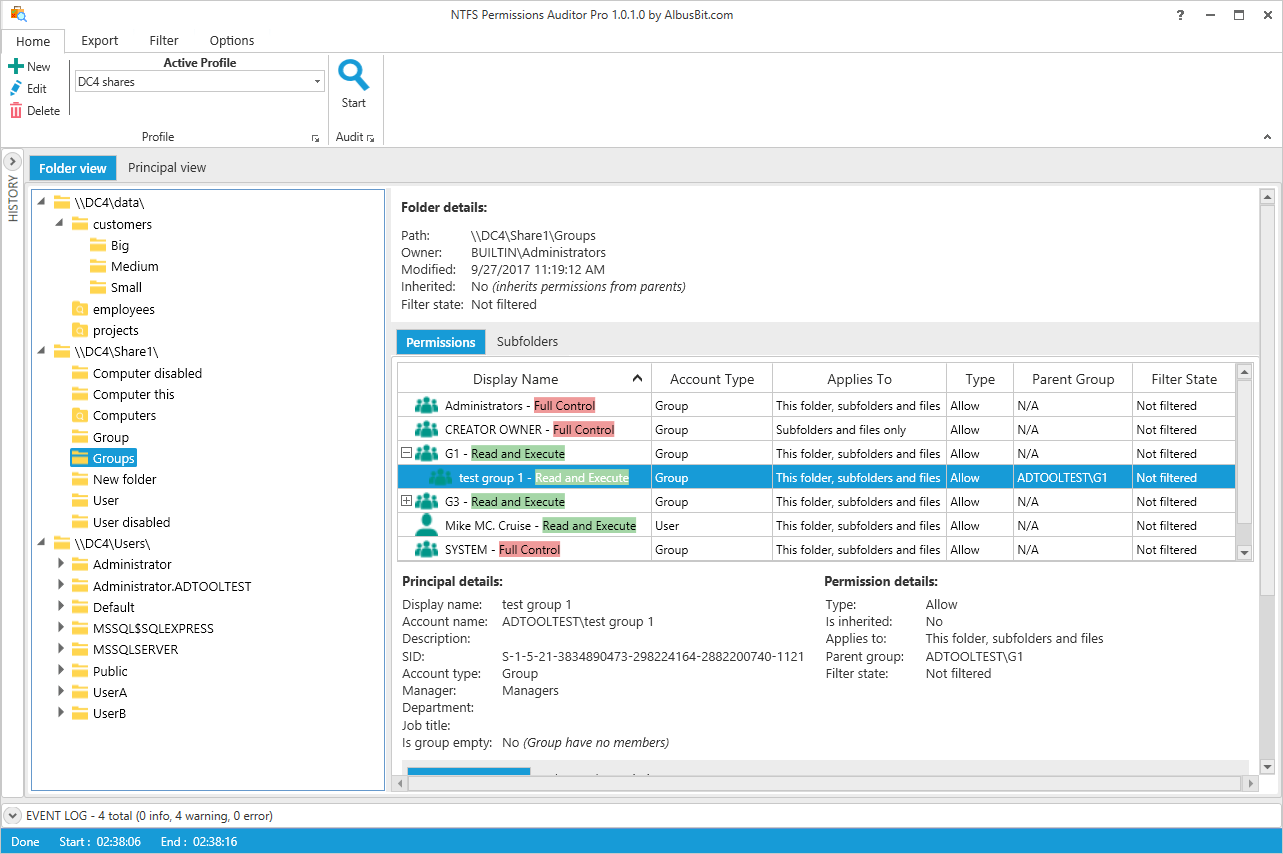
The folder tree view mirrors your Windows Explorer structure. Click on any folder to see its complete permission details: full path, owner, last modified date, every ACL entry, whether permissions are inherited or directly assigned, and the specific permission levels (Full Control, Modify, Read, etc.).
This is the fastest way to answer the question: "Who can access this specific folder, and what exactly can they do?"
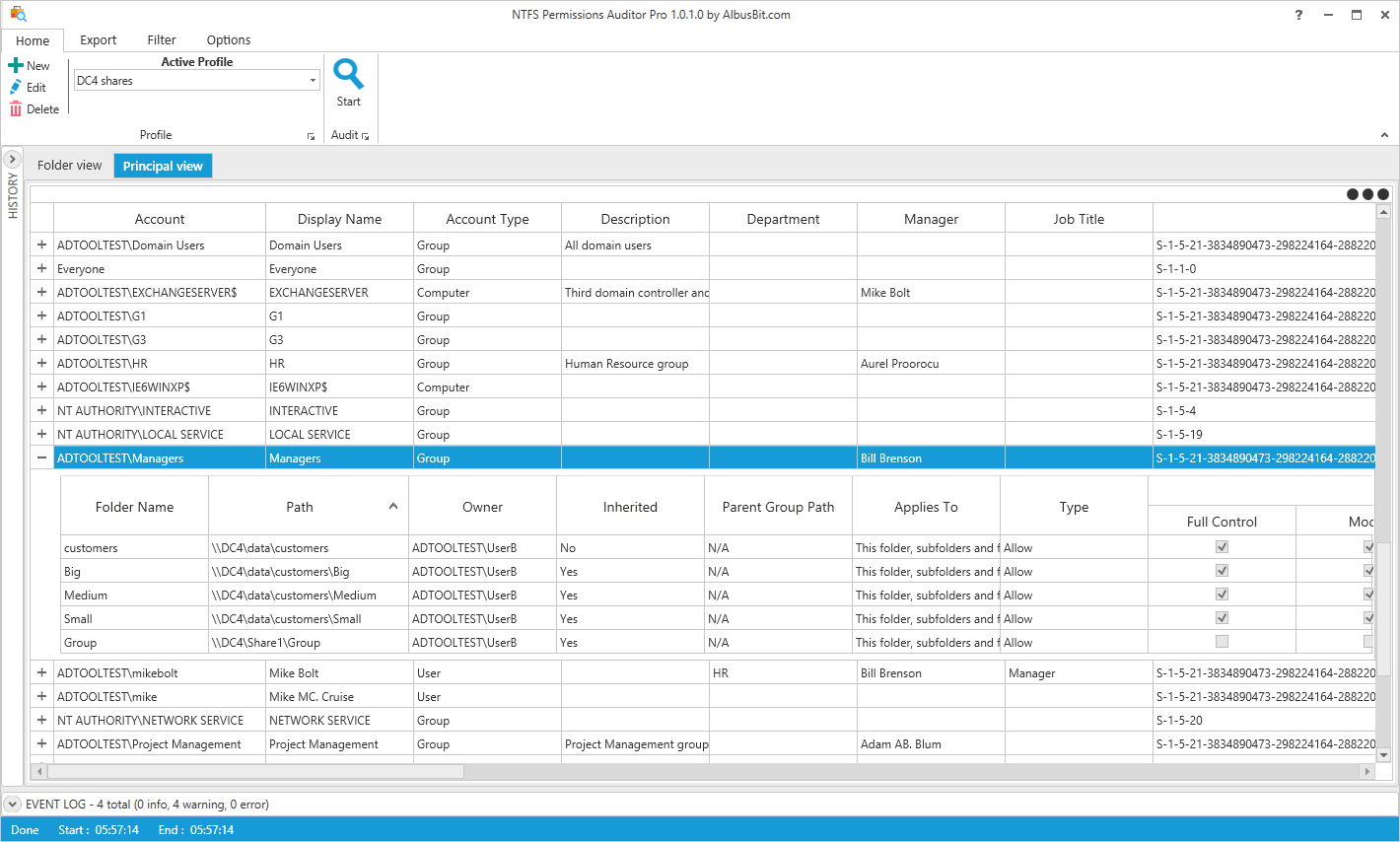
The account view flips the perspective: instead of asking "who can access this folder?", it answers "what can this specific user or group access?" Expand any account row to see every folder they have permissions to, including through nested group memberships.
This view is invaluable for user access reviews, onboarding/offboarding verification, and answering auditor questions about specific individuals.
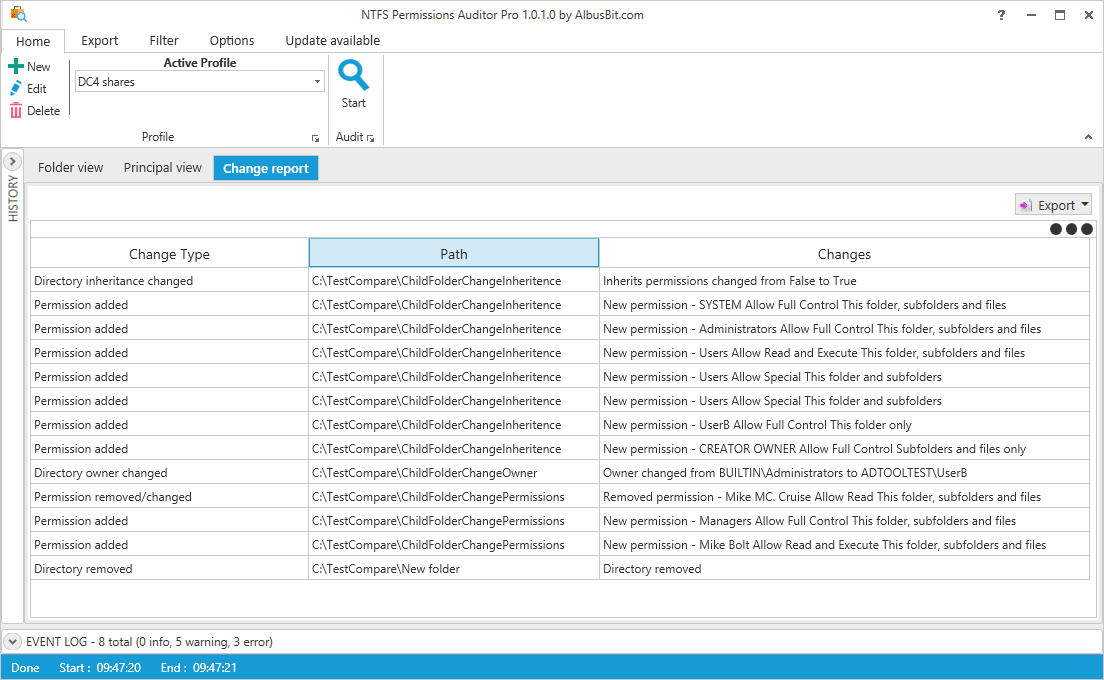
Compare any two audit results side-by-side. The change report highlights which directories, permissions, and group members were added, removed, or modified between audits.
This is the feature security teams rely on for continuous monitoring: schedule regular audits and immediately spot unauthorized permission changes or policy violations.
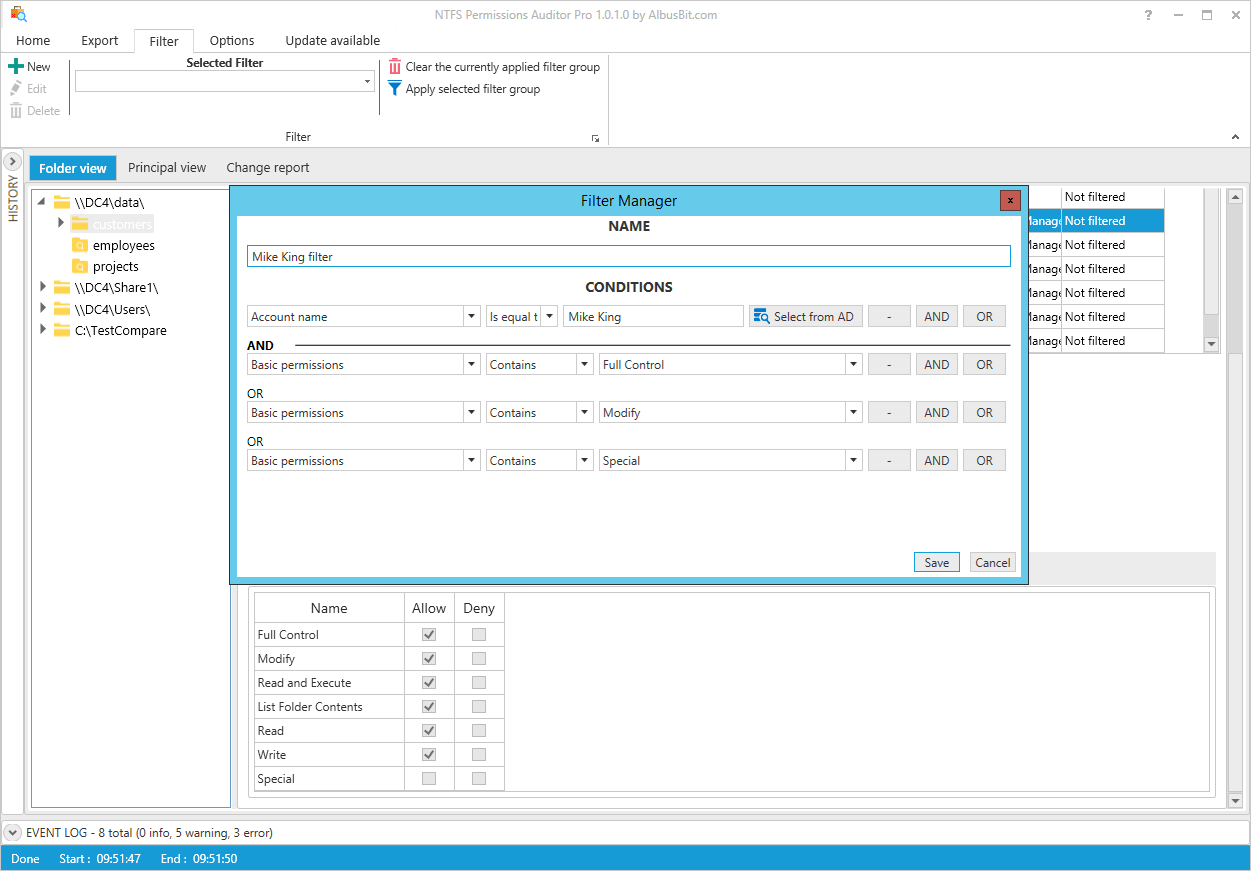
Create targeted filters to find exactly what you're looking for. For example: find all folders where "Mike King" has Full Control, Modify, or Special permissions — even if his access comes through nested group membership (e.g., he's a member of "Managers" which has permissions on the folder).
Filters can be applied during the audit process for faster scans, or after the audit is complete to drill into specific findings.
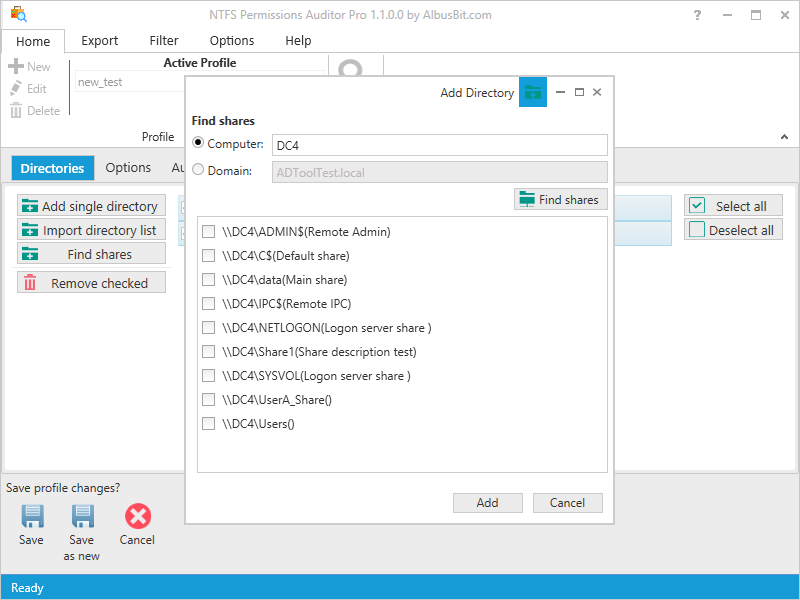
Don't know where all your shares are? Enter a server name to discover all its shares automatically. Or enter a domain name to find every computer and every share across your entire domain.
You can also import a list of share paths from a text file for repeatable audits across your environment.
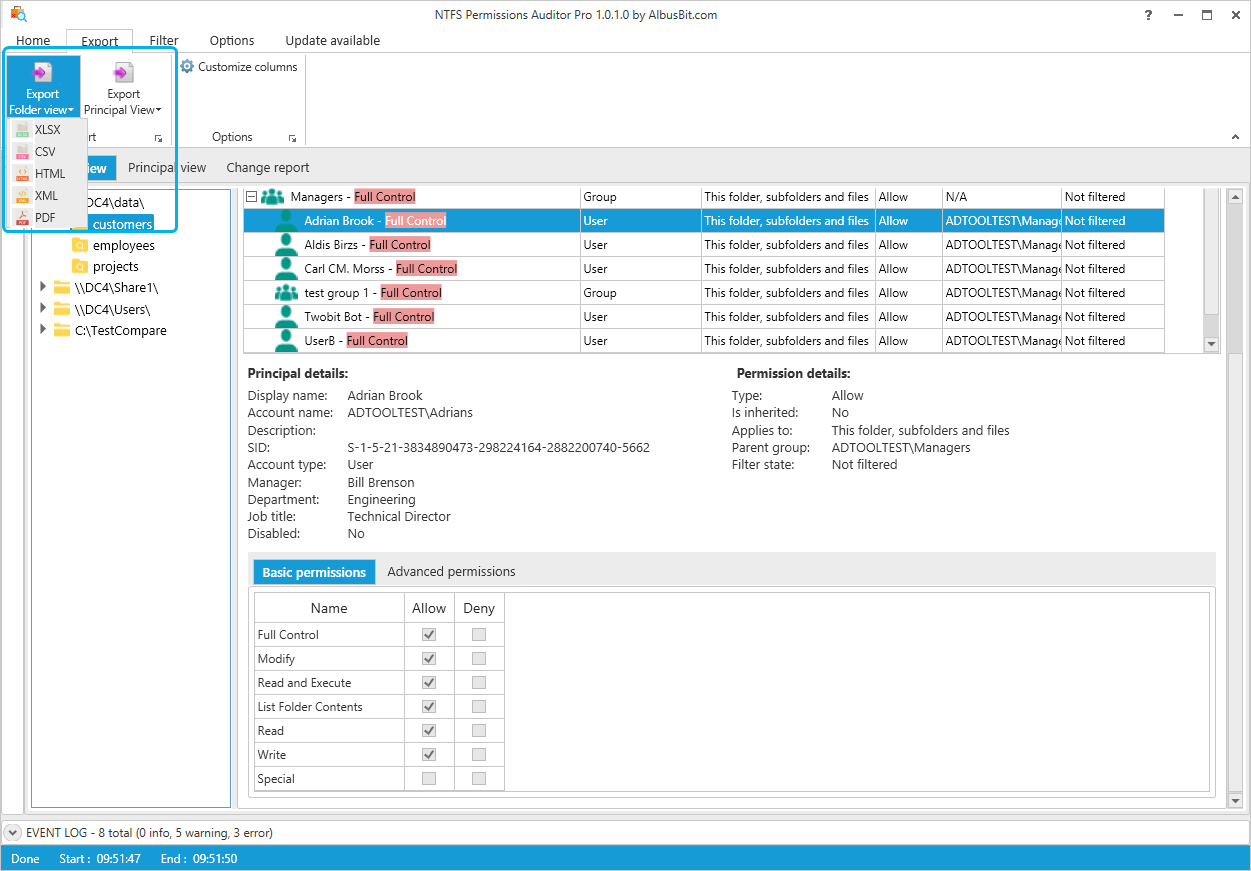
Export your audit results in the format your auditors or management need. Both folder view and account view exports are supported, giving you flexibility in how you present permission data.
| Folder view | Account view |
|---|---|
| Excel (XLSX) | Excel (XLSX) |
| CSV | CSV |
| HTML | HTML |
| XML | XML |
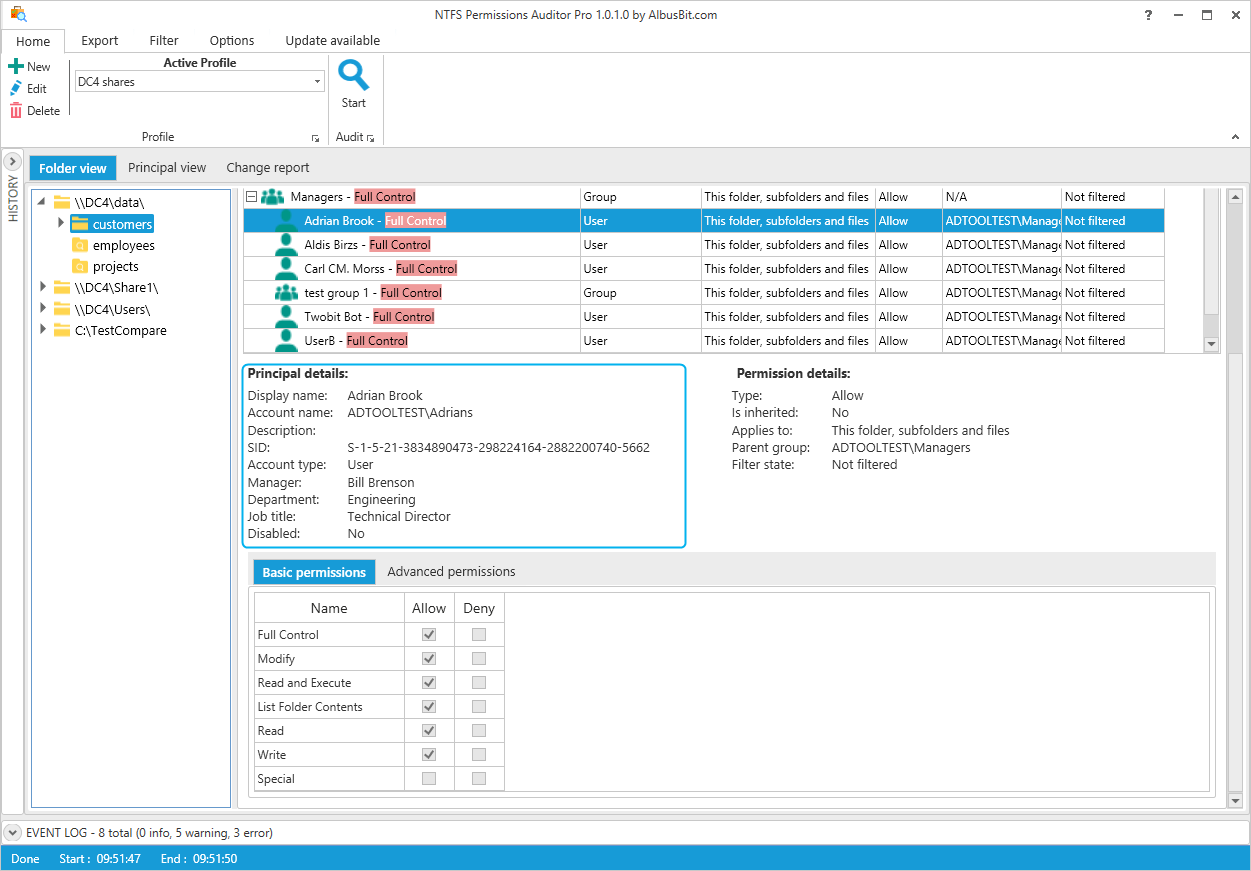
View detailed information for any account: display name, SID, description, department, manager, job title, and more. For group accounts, see direct and nested group members — essential for understanding the full scope of who actually has access through group membership chains.
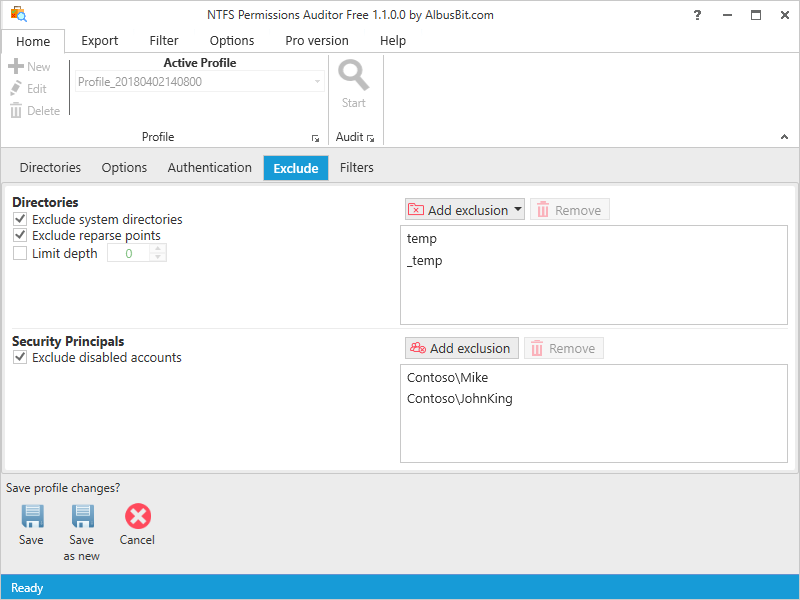
Exclude directories by exact path or name pattern, skip system directories and reparse points, set depth limits, and exclude disabled or specific accounts. This keeps your audit results focused on what matters and speeds up scan times on large file servers.
Schedule audits, export reports, and receive email notifications automatically
Set up automated audit tasks that run on a schedule. The Pro version can perform audits unattended, export reports to your preferred format, and email results to your team. Run in change report mode to get notified only when permissions change — ideal for continuous compliance monitoring.
Generate comprehensive permission reports for SOX, HIPAA, PCI DSS, GDPR, and other regulatory frameworks. Document who has access to what, track changes over time, and provide auditors with export-ready reports in the format they need.
Learn more about compliance reporting →Meet EU NIS2 requirements for access control management with the built-in NIS2 compliance dashboard, automated monitoring, critical change detection with email alerts, and one-click compliance report generation.
Learn more about NIS2 features →The free version has no time limit — use it as long as you need. Upgrade to Pro for export, filtering, scheduling, and change tracking.

| Free version | Pro version | |
|---|---|---|
| Audit an unlimited number of directories | ![]() |
![]() |
| Folder tree view | ![]() |
![]() |
| Account view | ![]() |
![]() |
| Export reports to CSV, Excel (XLSX), HTML, XML and PDF | ![]() |
![]() |
| Customize export fields | ![]() |
![]() |
| Advanced filtering during audit | ![]() |
![]() |
| Advanced filtering after audit | ![]() |
![]() |
| Automatic audit result storage | ![]() |
![]() |
| Change reports — compare two audit results and see what has changed | ![]() |
![]() |
| Scheduled automated audits with email reports | ![]() |
![]() |
| NIS2 compliance dashboard and reports | ![]() |
![]() |
| Guaranteed updates and bug fixes | ![]() |
![]() |
| Priority customer support | ![]() |
![]() |
| Buy Pro |
One-time purchase — use the software forever. Includes one year of updates and priority support. Renew annually at a discount to keep receiving updates.
NTFS Permissions Auditor: No-Nonsense file system security auditing and reporting.

Albus Bit NTFS Permissions Auditor is a lightweight, easy-to-use permissions analysis tool that helps you enforce the IT security principle of least privilege.
--Timothy Warner,
Microsoft Cloud and Datacenter MVP from Nashville, TN
(Source)
Windows operating system starting from Windows 10 and above (including Windows 11 and Windows Server 2022).
Microsoft .NET Desktop Runtime 10 - here is how to install .NET on Windows and here is the download link.