Online Manual
Report History & Storage
AD FastReporter stores generated reports in a local SQLite database so you can revisit previous results without re-querying Active Directory. This is a Pro feature.
Accessing Report History
Click HISTORY in the sidebar to see a list of all stored reports. The history view shows:
| Column | Description |
|---|---|
| Created | Date and time when the report was generated |
| Name | The report form that was used |
| Created by | The Windows user account that ran the report |
| Records | Number of AD objects found |
| Notes | Any additional information — for example, warnings about non-replicated attribute issues |
| Errors | Error messages from the generation process, if any |
| Filter | The filter criteria that were applied |
| Connection | Which AD connection was used |
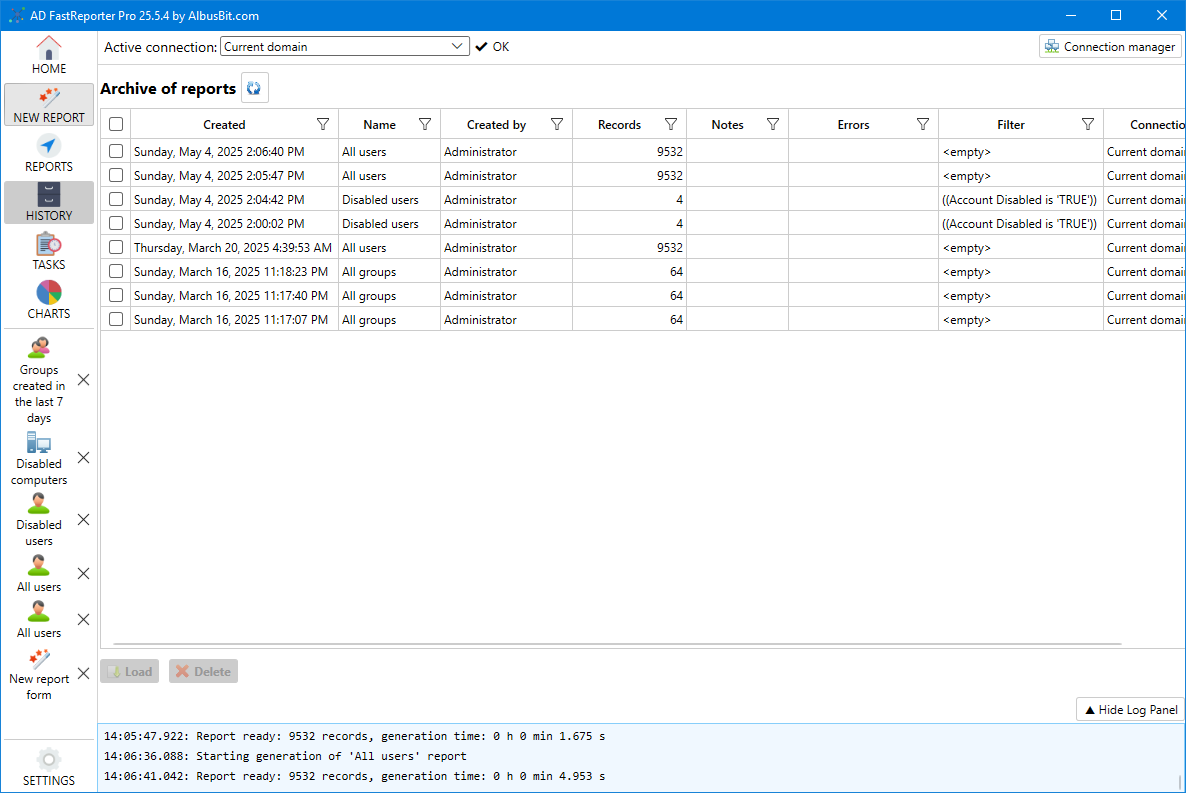
You can sort by any column by clicking the header, and use the filter row at the top of each column to narrow the list — for example, filter by report name to see all runs of a specific report.
Loading a Previous Report
To reload a stored report, select it in the history list and click Load (or double-click it). The report opens in a new tab with the same results as when it was originally generated. You can then sort, search, and export the data as usual.
This is useful for reports that take a long time to generate, or when you want to compare results from different dates without re-running the query.
Deleting History Entries
Select one or more reports in the history list and click Delete to remove them. This permanently removes the report data from the database. You’ll need to regenerate the report if you want the data again.
Regularly deleting old reports helps keep the database size manageable, especially if you generate large reports frequently.
Storage Settings
The storage behavior is controlled by settings in Settings → General:
Save reports in database — When enabled (the default), every generated report is saved to history automatically. Disable this if you don’t need to keep historical results and want to minimize database growth.
Save reports with results only — When enabled, only reports that returned at least one record are saved. Reports that returned zero results are not stored. This reduces clutter in the history.
Exception for NIS2 reports — NIS2 compliance reports are always saved regardless of the “results only” setting, because maintaining a compliance audit trail requires a record of every compliance check, even if no issues were found.
Database Location
Reports are stored in the SQLite database at:
%ProgramData%\AlbusBit\ADFastReporter\adfastreporter.db
This is the same database that stores your connections, custom report forms, task definitions, and other settings. On older installations, the database may have originally been at %LocalAppData%\AlbusBit\ADFastReporter\ — AD FastReporter automatically migrates it to the shared ProgramData location.
Database Size Management
The database starts small but grows with each stored report. The size depends on how many reports you generate and how many records each contains. A report with 10,000 user records and 15 fields will use more space than a report with 50 records and 3 fields.
To manage database size:
- Periodically delete old reports from the History view that you no longer need
- Disable “Save reports in database” if you only need exported files and don’t need to reload results later
- Enable “Save reports with results only” to skip saving empty reports
- The database file can be backed up or moved by copying the
.dbfile while AD FastReporter is not running
There is no automatic cleanup or retention policy — you control when old reports are deleted.
Use Cases for Report History
Compliance auditing — Keep a record of every compliance report run, with dates and results, as evidence for auditors. NIS2 compliance reports are automatically preserved for this purpose.
Change tracking — Generate the same report regularly (e.g., monthly) and compare results over time to detect changes in your AD environment — new accounts, disabled accounts, permission changes, expiring passwords.
Time savings — For reports that take several minutes to generate against a large directory, reload the saved results instantly instead of re-querying AD.
Sharing results — Load a previously generated report and export it in a different format, or re-send it by email to a different recipient, without needing to regenerate.