Online Manual
Settings Reference
Click SETTINGS in the sidebar to open the settings panel. Settings are organized into tabs: Connections, General, Fields, Debug, Email, License, and About.
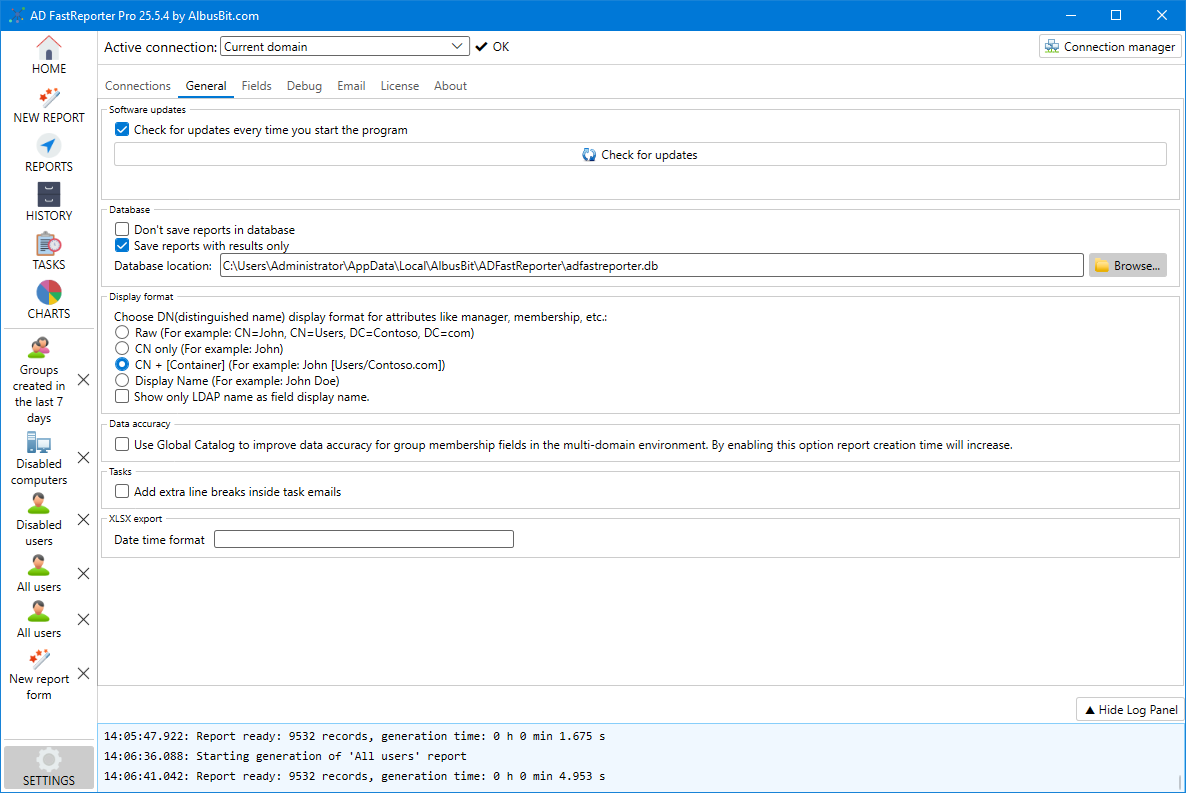
Connections Tab
Manage Active Directory connections — create, edit, duplicate, delete, and set the default connection. This tab is covered in detail on the Managing Connections page.
General Tab
Software Updates
Check for updates every time you start the program — When enabled, AD FastReporter checks for new versions on startup and shows a notification if an update is available.
Check for updates — Click to check for updates manually.
Report Storage
Don’t save reports in database — When checked, generated reports are not stored in the local database. Disabling storage means the Report History view will be empty for new reports. Existing stored reports are not affected.
Save reports with results only — When checked, only reports that return at least one record are saved. Zero-result reports are discarded. Exception: NIS2 compliance reports are always saved regardless of this setting.
Database Location
Shows the path to the SQLite database file. The default location is:
%ProgramData%\AlbusBit\ADFastReporter\adfastreporter.db
You can change the database location by editing the userSettings.json file in the application data folder. The ConnectionStrings:SqliteConnection value controls the database path.
Distinguished Name Display Format
Controls how DN (Distinguished Name) values are displayed in report results:
| Option | Example output |
|---|---|
| Raw | CN=John Smith,OU=Sales,DC=example,DC=com |
| CN only | John Smith |
| CN + [Container] | John Smith [Sales/example.com] |
| Display Name | The object’s displayName attribute value |
This setting affects fields like Manager, Group Members, MemberOf, and any other field that returns a Distinguished Name.
Show only LDAP name as field display name — When checked, field columns in the results grid show the raw LDAP attribute name (e.g., sAMAccountName) instead of the friendly display name (e.g., Logon Name). Useful for administrators who work directly with LDAP attributes.
Data Accuracy
Use Global Catalog to improve data accuracy for universal group membership fields — When enabled, AD FastReporter queries the Global Catalog (port 3268) to resolve universal group memberships more accurately in multi-domain forests. This may increase report generation time.
Task Email Formatting
Add extra line breaks inside task emails — When enabled, the plain-text email format used in scheduled tasks adds extra spacing between fields within each record, making the email more readable when there are many fields per record.
XLSX DateTime Format
Date time format — The date/time format string used when exporting to XLSX, ODS, and JSON. Examples: yyyy-MM-dd HH:mm:ss, dd/MM/yyyy HH:mm, MM/dd/yyyy. This affects how date columns appear in exported spreadsheets.
Startup
Open Dashboard at startup — When enabled, AD FastReporter opens the Home/Dashboard view when the application starts.
Fields Tab
View and manage report fields. The field list shows all available fields (built-in and custom) with their properties.
Select a field to see its details in the right panel: display name, LDAP attribute name, description, category, report types, and data type.
Show all fields — Toggle between showing all fields or only custom fields.
Add new field — Opens the dialog to create a custom LDAP field. Specify the display name, LDAP attribute, data type, and which report categories it applies to.
Delete this field — Removes a custom field. Built-in fields cannot be deleted.
Debug Tab
Enable debugging — Turns on detailed NLog-based logging. When enabled, log files are written during report generation, task execution, and other operations.
Log file folder — The folder where debug log files are stored. Default:
%ProgramData%\AlbusBit\ADFastReporter\logs
Click Browse to select a different folder.
Log files are named by date and level, e.g., 2026-03-29_Debug.txt. A separate file prefixed with _MS_ captures Microsoft framework-level logging (Entity Framework, .NET runtime).
Enable debugging when troubleshooting issues or when requested by support. Disable it during normal use to avoid unnecessary disk usage and slight performance overhead.
Email Tab
Configure SMTP settings for sending reports by email (manually from the results view or automatically from scheduled tasks).
| Setting | Description |
|---|---|
| Email Server Name (SMTP) | Hostname or IP of your SMTP server |
| Port | SMTP port (25, 465, or 587) |
| Use Secured Connection (SSL/TLS/STARTTLS) | Enable encrypted connection |
| Use authentication | Enable if the SMTP server requires login |
| User name | SMTP authentication username |
| Password | SMTP authentication password |
| Email sender’s address | The “From” address on sent emails |
| Default email recipient | Default “To” address — also used for NIS2 compliance alerts |
Test message — Click to send a test email to the default recipient using the current settings. If the test fails, check the server name, port, SSL setting, and credentials.
See Email Delivery for more details on sending reports by email.
License Tab
View and manage your AD FastReporter license.
License information — Shows the current license type (Free, Trial, or Pro), the licensed company name, order number, and support/updates expiration date.
Register a license key — Enter a Pro or Trial license key in the text field and click Register to activate it. Your connections, settings, and database are preserved when upgrading from Free to Pro.
Continue as Free version — If you don’t have a license key, click to register the Free version and start using AD FastReporter with the built-in report forms (without export, custom reports, or scheduling).
Try Pro for Free — Opens the trial request page on the Albus Bit website in your browser.
License expiry — When your support and updates period is approaching expiration, a notification appears with renewal options. After expiration, the application continues to work but no longer receives updates. You can renew at any time to resume updates.
About Tab
Shows the application name, version number, build date, company information, and credits. This information is useful when contacting support or verifying which version you’re running.