Online Manual
Report Categories & Built-in Reports
AD FastReporter includes over 250 built-in report forms organized across eight categories. Each category covers a different type of Active Directory object, and each is further divided into subcategories that group related report forms together.
Navigating the Report Catalog
Click REPORTS in the left sidebar to open the report catalog. The eight category tabs appear at the top of the view. Select a category to see its report forms in the left panel, grouped by subcategory. Click on a report form to see its description, included fields, and any predefined filters in the main area.
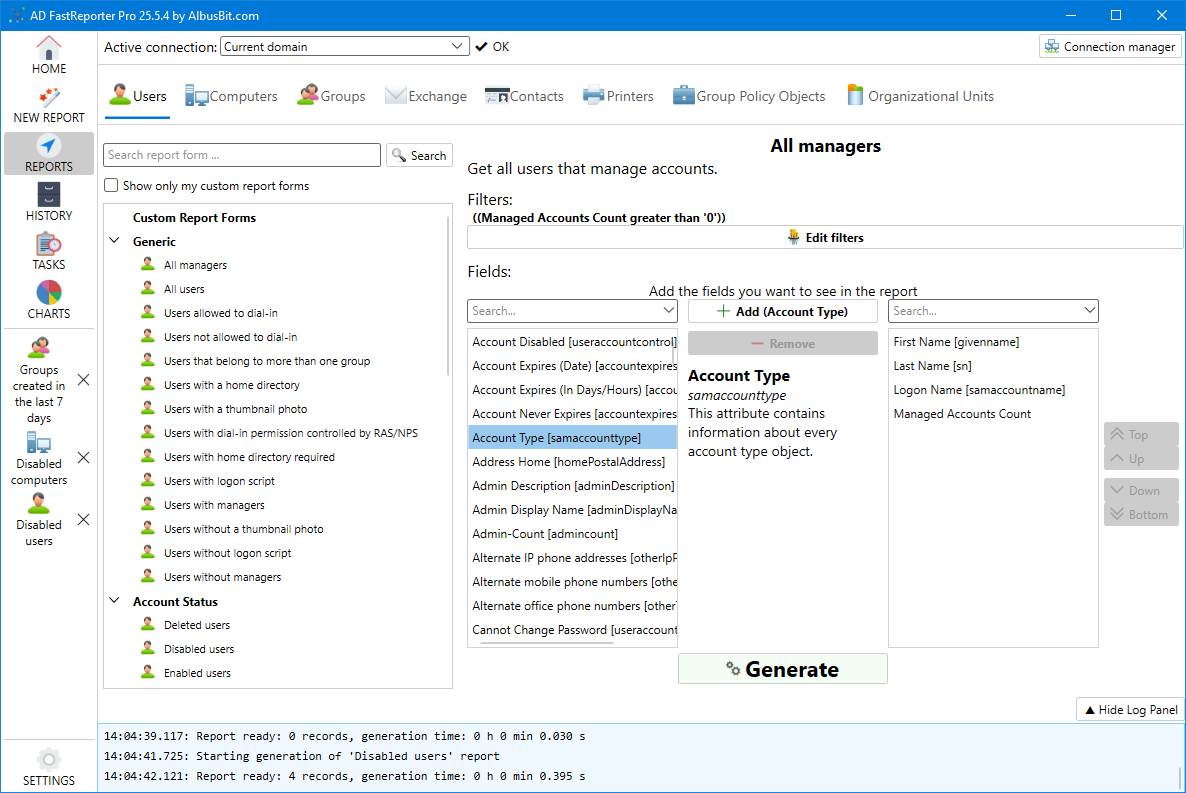
You can also find reports from the Home screen using the search box (type part of a report name), the Favorites section (reports you’ve starred), or the Recent section (the last reports you opened).
Every category also includes a Custom Report Forms subcategory where your own custom reports appear. See Custom Report Forms for details on creating your own.
Users
User reports cover Active Directory user accounts — the most commonly reported object type. Subcategories:
Generic — General-purpose user reports. Examples: all users, users by department, users by location, users with email addresses, users created in the last 30 days, users with specific account types.
Account Status — Reports focused on account flags and conditions. Examples: disabled accounts, locked-out accounts, accounts with “password never expires” set, accounts with specific User Account Control (UAC) flag combinations, accounts protected from accidental deletion.
Logon Status — Reports on user logon activity. Examples: users who haven’t logged on in 30/60/90 days, users who have never logged on, last logon date per user (queried from all domain controllers for accuracy), bad password attempt counts and timestamps.
Password Status — Reports on password state and expiration. Examples: users whose password expires in the next 7/14/30 days, users whose password has already expired, users who must change password at next logon, password last set date, accounts with reversible encryption enabled.
System — Reports on system-level attributes. Examples: SID values, distinguished names, canonical names, object GUIDs, when-created and when-changed timestamps, parent OU/container information.
User reports can draw from a wide range of AD attributes across multiple field categories: names and identity, address, organization, contact information, group memberships (direct, inherited, by scope and type), profile settings (home directory, logon script, profile path), Terminal Services/RDS settings, manager relationships, and more. See the Field Reference for the complete list.
Computers
Computer reports cover computer account objects in Active Directory. Subcategories:
Generic — General computer reports. Examples: all computers, computers by operating system, computers by OU, servers vs. workstations, computers created recently.
Logon Status — Reports on computer logon activity. Examples: computers that haven’t been active in 30/60/90 days (stale computer accounts), last logon timestamps, computers that have never been used.
OS — Reports focused on operating system details. Examples: computers grouped by OS version (Windows 10, Windows 11, Windows Server 2022, etc.), computers running outdated operating systems, service pack levels, OS build numbers.
System — System-level attributes for computer objects, similar to the User system subcategory.
Computer reports also support IP address fields (IPv4 and IPv6), BitLocker recovery information (Password ID, Recovery Key, Volume Name — requires appropriate AD permissions), and membership information.
Groups
Group reports cover both security groups and distribution groups. Subcategories:
Generic — Reports covering all group types. Examples: all groups, empty groups (groups with no members), groups by scope (domain local, global, universal), groups by OU.
Security Groups — Reports focused specifically on security groups. Examples: all security groups, security groups with their member counts, security groups with external members (members from other domains).
Distribution Groups — Reports focused on distribution groups and mail-enabled groups. Examples: all distribution groups, distribution groups with member counts.
System — System-level group attributes.
Group reports include fields for direct members, inherited (nested) members, member counts (direct and total), group scope, group type, managed-by information, and group membership (what other groups this group belongs to).
Exchange
Exchange reports cover mail-enabled objects in your Active Directory — users with mailboxes, mail-enabled contacts, and mail-enabled groups. This category is relevant if your organization uses Microsoft Exchange Server (on-premises). Subcategories:
Users — Exchange-enabled user accounts. Reports on mailbox settings, protocol status (OWA, POP3, IMAP4, MAPI enabled/disabled), Exchange server assignment, mailbox storage limits, delivery restrictions, and Exchange policy assignments.
Contacts — Mail-enabled contact objects with Exchange-specific attributes.
Groups — Mail-enabled distribution groups with Exchange-specific attributes like delivery restrictions and accept-messages-from settings.
Exchange reports draw from Exchange-specific AD attributes (msExch* attributes) that are present when Exchange Server has extended the AD schema.
Contacts
Contact reports cover AD contact objects — entries that represent external people who don’t have user accounts in your directory. These are commonly used for address book entries in Exchange environments. Subcategories:
Contact Information — Reports on contact names, email addresses, phone numbers, organization details, and other standard contact attributes.
Printers
Printer reports cover printer objects published in Active Directory. These are printers that have been shared and published to AD for discovery by users.
Reports include printer name, location, server name, share name, and other printer-specific attributes. There are no subcategories — all printer reports appear in a single group.
Group Policy Objects
GPO reports cover Group Policy Objects stored in Active Directory. Subcategories are not subdivided further. Reports include:
- GPO name, display name, and description
- GPO status (enabled, user configuration disabled, computer configuration disabled, or fully disabled)
- GPO links — which OUs, sites, and domains a GPO is linked to (resolved from
gPLinkattributes across the directory) - System attributes (created date, modified date, GUID, distinguished name)
GPO link resolution is a particularly useful capability — AD FastReporter queries all OUs, sites, and the domain root to determine where each GPO is applied, giving you a complete picture of GPO assignment in a single report.
Organizational Units
OU reports cover the organizational unit structure of your directory. Reports include:
- OU name, description, and distinguished name
- Parent container and path information
- Child object counts — how many users, computers, and groups are directly contained in each OU
- Protection from accidental deletion flag
- GPO links applied to the OU
- System attributes (created date, modified date)
Child object counts are calculated fields — AD FastReporter counts the actual objects within each OU, giving you a quick overview of how your directory is structured and how populated each OU is.
Custom Report Forms
Every category includes a Custom Report Forms subcategory. When you create a custom report form or duplicate a built-in one, it appears here in the category that matches its report type (Users, Computers, Groups, etc.).
Custom reports are a Pro feature. In the Free edition, you can use all 250+ built-in report forms, but you cannot create or modify custom report forms.
What to Do Next
Once you’ve found a report form you want to run, see Generating Reports for how to select fields, run the report, and work with the results. If the built-in reports don’t quite match your needs, see Custom Report Forms to learn how to create your own.